Monday, 19 December 2011

Coronation of King George VI


Picture author: Henri Cartier-Bresson
Picture date: 12th May 1937
Published in: French Regard weekly magazine

Mr. Cartier-Bresson took this picture on Trafalgar Square on the coronation date of King George VI. Year 1936 was difficult for British nation. King George V died after long reign, and King Edward VIII abdicated after a year of reign to marry American socialite. King George VI took over the throne in times when people were not respectful towards monarchy.

Regard magazine was not happy that Henri Cartier-Bresson covered the coronation day, but did not shoot even one picture of the king or the carriage. Photographer took the picture of the crowd waiting to see the coronation, and the sleeping man who was waiting overnight and fell asleep. The man and photographer are missing coronation process, but the interests of the person behind the camera are to show the crowd who is divided, but united in the same moment. He portrayed historic moment in faces of people who saw how history is being created. He portrayed their faces, cheering and dancing. His lens covered it all.

Monday, 12 December 2011

Henry Ford and Model T


Picture date: 1921
Picture published by: Henry Ford Museum

The above picture depicts Henry Ford and his ground-breaking car, Model T. It was shot in Buffalo, New York in 1921. In the same year about 1 million Model Ts came out from his assembly lines. Henry Ford was a car entrepreneur of the century who developed the technique of mass production and assembly lines. He was responsible for revolution in automobile and transportation industries.

Before releasing Model T, Henry Ford was working with 19 prototypes for five years. Those models were named from A to T which was actually the final model. The release of Model T marked the beginning of affordable cars for masses. The original price of Model T was $850 or £180. After including the inflation, the price estimates around $20.000. It was a half or one third of the price of other cars at that time. the price dropped eventually to $300 by 1920s. Mr. Ford decided that due to the success of Model T, the next model will not be Model U, but 'Ford Model A' to begin naming from the start.

Monday, 5 December 2011

The Man and the Mouse


This picture depicts Walt Disney and the silhouette of Mickey Mouse. Mickey Mouse was created by him and eventually became a symbolic figure of American culture. Mickey Mouse was at first the replacement for Oswald the Lucky Rabbit, but when Disney lost rights to him, he decided to leave Universal Studios and start his own cartoon series. Mickey Mouse was the animation response to Charlie Chaplin, and Disney was very sensitive about his appearance.

Mickey Mouse debuted in Plane Crazy in May 1928, but received wide recognition six months later when Steamboat Willie was released. It was a parody of Buster Keaton's Steamboat Bill Jr., but with addition of the sound it became very successful.

In 1959, Mickey Mouse became a true American symbol when Nikita Khrushchev visited Los Angeles and requested to visit the Disneyland. However, his wish could not be fulfilled because of security reasons.

Monday, 28 November 2011

Abbey Road


Picture author: Iain Macmillan
Picture date: 8 August 1969
Publish date: 26 September 1969

"Abbey Road" is a record with probably the most famous cover in history. Especially when you think about all of the tourists and drivers who go there to visit the spot on that street, or even recreate the cover. According to officials, this crossing is a "death trap" for tourists, and there were 22 accidents at the crosswalk since 2000. The crossing was given grade II listed status for its "cultural and historical importance" in December 2010.

Album cover did not include band's name or its title, which was actually an indication of band's fame and status, and become one of the most successful Beatles albums. It was Paul McCartney's idea to make a cover with four ban members outside Abbey Road studios. Iain Macmillan was taking photos while a policeman held the traffic back from the crossing. He had ten minutes to make photos, so he took six pictures, and the cover features fifth one with all band members with legs in perfect "V" formation. 

The picture presents all group members crossing the street in single file from left to right. Lennon is leading, Star, McCartney and Harrison follow him. The group is wearing suits designed by Tommy Nutter, but Paul McCartney is barefoot, because he turned up on the shooting day wearing sandals, and he kicked them off after the first two takes. 

Monday, 21 November 2011

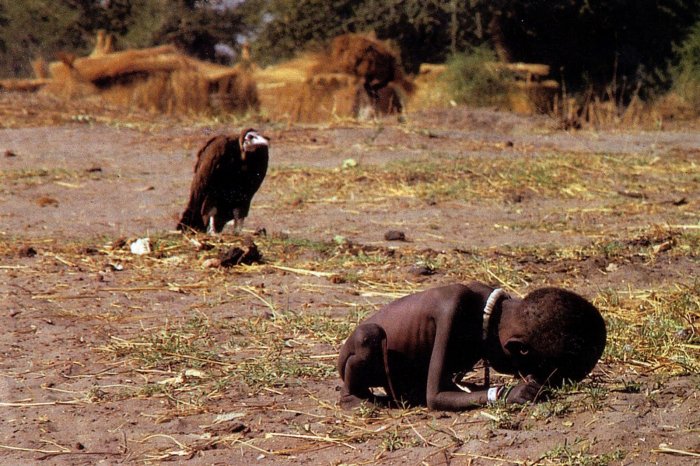
Vulture Stalking a Child


Author: Kevin Carter
Picture date: March 1993
Picture published: March 26, 1993 in New York Times


Mr. Carter took a trip to Southern Sudan in March 1993, where he took this photo. He was preparing to take a photo of a child trying to reach to feeding centre when the vulture landed. He waited for 20 minutes for the vulture to spread wings and took off, but it did not happen. So, he took the photo and chased the vulture away.

The photo was bought by New York Times and published on March 26, 2003 and gained a constant notice of hundreds of people calling to the newspaper and asking if the girl was saved. The newspaper made even a special editor's note that child had enough strength to walk away from the vulture, but her fate was unknown. Mr. Carter received much criticism for not helping the girl, even if journalists were told not to touch victims of famine. The St. Petersburg Times in Florida said about him: 

The man adjusting his lens to take just the right frame of her suffering might just as well be a predator, another vulture on the scene.

The photo won Pulitzer Prize for the photo, a very precious award for a journalist. Even after then, Mr. Carter could not enjoy the prize and confined to a friend he is really sorry for not picking the girl up. He was consumed by the violence he witnessed and haunted by the girl's fate as he did not help her, he committed suicide three months later.

Monday, 14 November 2011

When Putin met Reagan


Picture date: May 1988
Picture author: Pete Souza

The photograph was taken during President's Regan visit in Moscow. He went there for 4th summit with Mikhail Gorbachev. Soviets prepared very warm welcome, buildings near Kremlin were repainted, streets repaved, and plants and trees planted. But the visit did not omit some diplomatic failures.

When the Reagans took an unscheduled walk and went shopping on one Moscow street, they were crowded by Russian pedestrians. They were suddenly surrounded by Russian secret police, and Mr. Reagan was supposed to say that Russia is still "a police state". On the other hand, the President fell asleep halfway through the performance in Bolshoi Theatre and Secretary Gorbachev had to tap his shoulder to wake him when the curtains were going down.

The most meaningful incident was revealed only 20 years later. The man with a camera around his neck, standing behind the boy was Russian Prime Minister (former Russian President), Vladimir Putin. During these days he was acting as a KGB agent, and on that day he was pretending to be a tourist. That day, Gorbachev introduced Reagan to a group of tourists who asked him pointed questions about about subjects as human rights in the United States. The photographer, Mr. Souza, asked a Secret Service agent that he cannot believe that regular tourists can ask such pointed questions. The agent replied that those tourists are all KGB families.

The Kremlin, however, denied that the man on the photograph was Vladimir Putin.

Monday, 7 November 2011

Kozakiewicz’s gesture


Picture date: July 30, 1980

This picture was taken on the 1980 Summer Olympics Games in Moscow which were controversial from the beginning. They were boycotted by the USA and several other countries because of the Soviet invasion of Afghanistan. Despite boycott, athletes from these countries participated in Olympics Games under Olympic Flag and Hymn what was criticised and censored by the Soviet television.

Władysław Kozakiewicz, from whom the gesture's name comes from, made the gesture on July 30, 1980 to Russian spectators in the stadium. The hostile, jeering crowd was rooting for Soviet jumper Konstantin Volkov, even during Kozakiewicz's spectacular performance. Having just secured his gold medal position, Kozakiewicz made the gesture in defiance to the Soviet crowd. To many, it signified Polish resentment of Russia’s control over Eastern Europe; in Poland, the gesture became immediately known as Kozakiewicz’s gesture.

After the Olympics, the Soviet ambassador to Poland demanded that Kozakiewicz be stripped of his medal over his “insult to the Soviet people”. The official response of the Polish government was that the gesture had been an involuntary muscle spasm caused by his exertion. Kozakiewicz for his part promptly defected to West Germany.